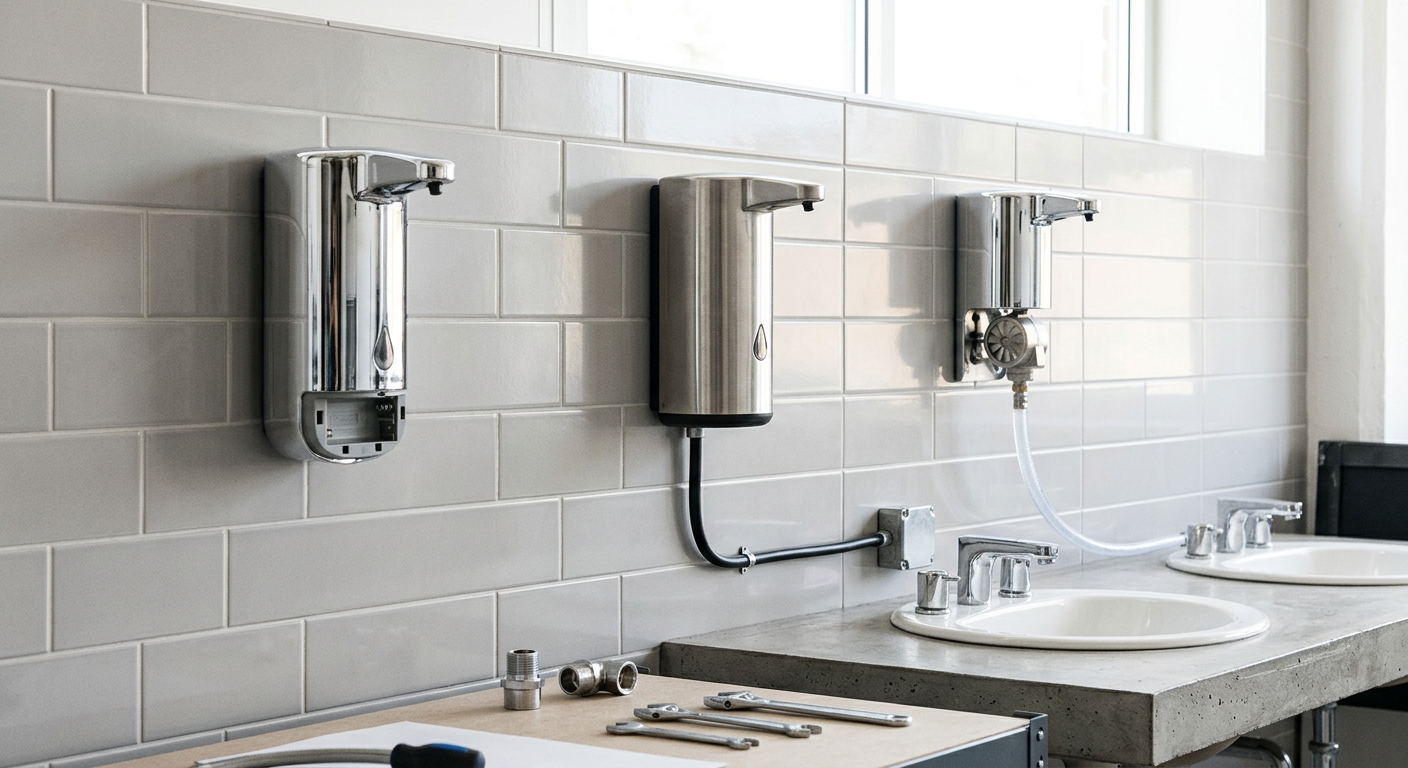
Choose hardwired for restrooms with continuous traffic where sensor consistency and zero maintenance downtime matter most. Choose battery for retrofit installs and moderate-traffic locations where running low-voltage wiring isn’t practical. Choose hydropower only where you can verify sink flow rates meet the turbine’s minimum threshold, because these units fail quietly when supply pressure drops during peak building demand.
How Power Source Affects Sensor Range
Automatic soap dispensers use infrared proximity sensors, typically rated for 3 to 6 inches of detection range. That range is not fixed. It’s a function of the IR emitter’s output voltage, and every power source delivers voltage differently over its service life.
A hardwired unit running on regulated 6V DC holds steady output for the life of the transformer. A battery-powered unit starts at full range when batteries are fresh, then drifts shorter as voltage sags. Facility managers who get complaints about dispensers that “used to work fine” are usually looking at a battery problem, not a sensor defect.
Battery Drain and Detection Distance Drift
Battery-powered dispensers typically run on 4 AA alkaline cells or a lithium 9V pack, depending on the manufacturer. Alkaline AAs are the most common spec because they’re cheap and universally stocked, but they show voltage drop earlier in their discharge curve than lithium cells. In a high-traffic restroom running 200+ activations a day, expect alkaline AA replacement every 2 to 3 months. Lithium packs in the same duty cycle often run 4 to 6 months before replacement, at a higher per-unit cost.
The practical issue is that sensor range doesn’t drop off a cliff. It degrades gradually, so a dispenser might go from a 5 inch detection range down to 2 inches over several weeks. Users start waving their hands closer and closer, then eventually assume the unit is broken and either stop using it or force pump it manually, which defeats the point of touchless dispensing in the first place.
- Alkaline AA: lowest upfront cost, shortest service interval under heavy use, most common cause of range complaints
- Lithium 9V or lithium AA: higher cost per unit, longer flat-voltage discharge curve, more consistent range until near end of life
- Rechargeable NiMH: viable for low-traffic units, but self-discharge and inconsistent charge cycles make this a poor fit for facilities without a dedicated battery management routine
Hardwired Reliability in High-Traffic Restrooms
Hardwired dispensers require a low-voltage transformer, typically stepping down building power to 6V DC, wired to a junction box behind or below the fixture. This is the same low-voltage approach used in sensor faucet ranges, where consistent detection distance across thousands of daily cycles matters more than installation simplicity.
The tradeoff is upfront labor cost. Running conduit and pulling wire to a wall-mounted dispenser adds electrician time that a battery unit skips entirely. For airports, stadiums, hospitals, and any restroom bank with continuous use, that labor cost amortizes quickly against the alternative of a maintenance tech replacing batteries weekly. For a single-user office restroom seeing 20 activations a day, hardwiring is often not worth the install cost.
Hydropower Units and Thick Soap Compatibility
Hydropower dispensers generate their own electricity from water flow through a small turbine integrated into the supply line, eliminating batteries and wiring entirely. The catch is a minimum flow requirement, often around 0.5 GPM, below which the turbine doesn’t generate enough voltage to fire the sensor and pump reliably.
This matters more than it looks on a spec sheet. Low-flow aerators, pressure-reducing valves, and older building supply lines can all push actual flow below that 0.5 GPM threshold, especially during peak demand when several fixtures draw simultaneously. A hydropower dispenser that tested fine during installation can start missing activations six months later if building supply pressure changes or a valve gets partially closed during other maintenance work.
Soap viscosity compounds this problem. Foam soaps and thin liquid soaps move easily through a hydropower unit’s internal pump even at marginal flow. Thick gel soaps and antibacterial formulations with higher viscosity need more consistent mechanical force to push through the tubing and nozzle. Pair a viscous soap with borderline flow and you get inconsistent dispensing, partial pumps, or no output at all, which reads to building occupants as an empty or broken unit even when there’s plenty of soap in the reservoir.
Maintenance Access and Clog Troubleshooting by Type
Clogging risk isn’t really about power source directly. It’s about how power source affects your ability to diagnose and fix a clog quickly.
| Power Type | Common Clog Cause | Diagnostic Difficulty |
|---|---|---|
| Battery | Dried soap residue in nozzle from infrequent use or thick soap left standing | Low. Pull batteries, remove nozzle, flush with warm water |
| Hardwired | Same nozzle residue issues, plus occasional pump motor wear from continuous cycling | Moderate. Access usually requires opening a wall-mounted housing, may need electrician if wiring is suspected |
| Hydropower | Soap residue plus flow-related pump stalling under low viscosity-flow combinations | High. Requires checking both mechanical clog and supply-side flow rate before replacing parts |
Hydropower units are the hardest to troubleshoot because a symptom like “not dispensing” could mean a physical clog, insufficient flow, or a viscosity mismatch, and each has a different fix. Battery and hardwired units at least isolate the problem to the dispenser itself, since neither depends on ongoing water flow to generate power.
Matching Power Source to Facility Duty Cycle
The right choice depends on activations per day, soap viscosity, and how much downtime your facility can tolerate before a dispenser complaint becomes a maintenance ticket.
- Under 50 activations/day, low-viscosity soap, retrofit install: battery-powered, alkaline AA acceptable
- 50 to 150 activations/day, mixed soap types: battery-powered with lithium cells, or hardwired if wiring access exists
- 150+ activations/day, continuous restroom traffic: hardwired, 6V DC transformer, sized to avoid voltage sag across multiple units on one circuit
- Any duty cycle with viscous or gel soap: verify hydropower turbine flow rating against actual measured supply flow before specifying, not just the fixture’s rated minimum
Facilities running dispensers as part of a larger restroom fixture package should confirm all units on a shared transformer or circuit don’t collectively exceed the transformer’s rated output, since undersized transformers cause the same voltage-drop symptoms as failing batteries.
What to Check Before You Specify
Measure actual flow rate at the fixture location if you’re considering hydropower, not just the building’s nominal supply rating. Confirm soap viscosity against the manufacturer’s compatibility list before ordering in bulk, since a formulation change from foam to gel can turn a working hydropower installation into a maintenance problem. For hardwired specs, confirm your electrician is quoting a regulated 6V DC transformer sized for the total number of units on that circuit. If a facility already has recurring sensor-range complaints, check battery type and replacement interval first before assuming the sensor itself has failed.